
-
Why glass matters: history and basics3 Topics
-
Where and how glass is used today3 Topics
-
State of glass waste and recycling3 Topics
-
Collection systems and actors3 Topics
-
Sorting, processing and making cullet3 Topics
-
Remelting, quality and markets3 Topics
-
Environmental, economic and policy aspects3 Topics
-
Practical implementation and teaching resources3 Topics
Participants 9


Economic and social importance

travellingteacher256 April 13, 2026
Lesson Progress
0% Complete
Quick summary
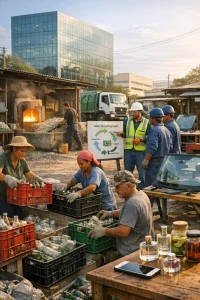
- Glass isn’t just “broken bottles” — it’s a backbone material for big industries (packaging, construction, automotive, electronics) and a source of livelihoods from collection to remelting.
- Keeping glass in use (high recovery and high cullet share) reduces costs, energy and imports of raw materials, and creates jobs across formal and informal sectors — which matters a lot in the Global South where local jobs and resilient supply chains are priorities.
- Below are easy-to-teach points, industry links, examples of how value flows through the system, and classroom prompts you can use with TVET or high‑school learners.
Why glass matters to industry (short, practical overview)
- Packaging (bottles and jars)
- Biggest visible use: food, beverages, spirits, cosmetics and pharmaceuticals.
- Glass containers are inert (won’t leach), preserve flavour and are preferred for certain products — which keeps demand steady.
- Construction (flat glass)
- Windows, façades, mirrors, insulating glass units — all need float/architectural glass.
- Urban growth and building refurbishments in many Global South cities keep demand for flat glass high.
- Automotive
- Windscreens, side and rear glass are safety-critical components. Automotive glass is specialised and needs high-quality feedstock.
- Electronics and speciality glass
- Screens (phones, tablets, TVs), optical fibres and technical glass for labs and instruments.
- These markets drive demand for high-purity, high-performance glass types.
- Cross-cutting: glass fibre and specialty industries
- Fibreglass and specialty glass products support manufacturing and infrastructure projects.
How glass supports trade, local industry and resilience
- Local manufacturing value chain
- Raw materials (sand, soda ash, limestone) → glassmaking → product forming → distribution → collection → remelting.
- Each step involves jobs and businesses: miners and transporters, glassworks, bottle-makers, distributors, retail, waste collectors, sorters, remelters.
- Reduced import dependency
- Using recycled glass (cullet) reduces demand for some imported raw materials and energy — important where foreign exchange is constrained.
- Trade and exports
- Countries with glassmaking capacity export containers, flat glass and specialty products. Even if finished goods are not exported, domestic production saves import costs and supports local industry.
- Value retention in local economies
- When glass is collected and remelted locally, the economic value remains in-country instead of being lost to landfill or exported as low-value waste.
Employment and livelihoods — formal and informal
- Formal sector jobs
- Glass plants, warehousing, logistics, quality control, engineering, sales and admin.
- Secondary industries (construction glazing services, auto glass fitters, screen repair) add more formal employment.
- Informal sector importance (especially in the Global South)
- Waste pickers, small-scale sorters and aggregators collect and supply glass to remelters or to traders.
- For many low-income households, collecting and selling glass provides an important, flexible income stream.
- Formal systems that ignore the informal sector miss an opportunity: inclusive systems that integrate and fairly compensate informal workers increase recovery and reduce social harm.
- Skills and upskilling
- Glass recycling and remelting require skills (sorting, contamination control, furnace operation) — creating opportunities for TVET training and local skills development.
Economic and environmental benefits of keeping glass in use
- Direct cost savings for manufacturers
- Cullet (recycled glass) replaces part of the raw batch, lowers melting temperatures and reduces glass furnace energy costs — saving money per tonne of production.
- Energy and emissions
- Melting more cullet generally reduces energy use and CO2 per tonne of new glass — so recycled glass is both economically and environmentally valuable.
- Reduced landfill costs and pollution
- Diverting glass from landfill saves space and avoids costs associated with municipal waste disposal; it also reduces litter and health hazards.
- Local circular economy multiplier
- Every stage that is done locally (collection, sorting, reprocessing) multiplies economic benefits: wages spent locally support shops and services.
Practical metrics to use in class (simple, actionable)
- Recovery rate = (tonnes of glass collected for recycling / tonnes of glass waste generated) × 100
- Useful to measure how effective a local system is.
- Cullet share = (tonnes of recycled glass used in furnace / total tonnes of glass batch) × 100
- Shows how much recycled material a factory uses — higher cullet share = lower energy use.
- Basic impact questions that students can estimate or research locally:
- If a plant increases cullet share by 10 percentage points, how might its energy use or fuel costs change? (Prompt learners to research supplier or industry fact sheets for precise numbers.)
- How many informal collectors are active in a local municipality? What income do they earn? How could integrating them into a formal system change outcomes?
Inclusive practice — why it matters for livelihoods
- Recognise and map the informal workforce
- Informal collectors are often the backbone of glass recovery; mapping them helps design fair systems.
- Design for inclusion
- Payment points, co-operatives, aggregation hubs and training help formalise incomes without destroying livelihoods.
- Simple incentive examples
- Small cash payments, in-kind benefits (food vouchers, PPE), or integrating collectors into municipal collection contracts can dramatically improve recovery and worker wellbeing.
- Social co‑benefits
- Better collection increases local cleanliness, reduces disease risk, and creates predictable income flows.
Short classroom activity (15–30 minutes)
- Local value-chain mapping
- Ask learners to map the local glass value chain on a single sheet: where does glass get made, sold, used, discarded, collected, and remelted?
- Identify who benefits (jobs, incomes), and who loses when glass is landfilled.
- Discuss one change that would increase local jobs without harming the environment (e.g., a small remelt facility, sorting hub, or co‑operative for waste pickers).
Key takeaways to give learners
- Glass is a strategic material: it supports many industries and many jobs.
- Recycling glass keeps value in local economies, reduces costs and energy use, and can improve livelihoods if systems are designed inclusively.
- Simple metrics (recovery rate, cullet share) let communities measure progress and make practical decisions.
Further reading (short list for educators)
- FEVE / Glass Alliance Europe: factsheets on glass recycling and benefits (good for global/container stats).
- UNEP / World Bank “What a Waste” and Global Waste Management Outlook — context on waste streams and recovery.
- Ellen MacArthur Foundation — circular economy principles applied to materials like glass.
- Local government or industry reports (e.g., national environment agencies, glass manufacturers’ sustainability reports) — useful for country-level figures and case studies.
If you want, I can:
- Draft a one‑page non‑technical summary (A4) of this content for learners.
- Pull together a short list of up‑to‑date reports and one‑page sources (5–30 pages) focused on Africa/South Africa for your research component. Which would you prefer next?