-
Why glass matters: history and basics3 Topics
-
Where and how glass is used today3 Topics
-
State of glass waste and recycling3 Topics
-
Collection systems and actors3 Topics
-
Sorting, processing and making cullet3 Topics
-
Remelting, quality and markets3 Topics
-
Environmental, economic and policy aspects3 Topics
-
Practical implementation and teaching resources3 Topics
Participants 9


Practical implementation and teaching resources
travellingteacher256 April 13, 2026
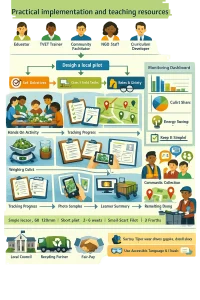
Welcome — this lesson is the hands‑on bit. If the earlier lessons gave you the “why” and “what” of glass recycling, this one shows you the “how” as an educator or TVET trainer. We focus on simple, low‑cost, practical ways to run a local pilot or classroom module, involve communities (including informal collectors), and keep monitoring short and useful. Everything here is designed so you can turn waste glass into a local teaching opportunity without needing a lab or a big budget.
Who this lesson is for
- Educators, TVET trainers and school coordinators
- Community facilitators and NGO staff running local recycling pilots
- Curriculum developers who want ready‑to‑use, non‑technical activities for learners
What you’ll get from this lesson
- Clear steps to design a local pilot or single lesson
- Ready ideas for classroom and field activities (low tech, safe, inclusive)
- Simple monitoring tools and short 1‑page learner summaries you can adapt and print
- Practical tips for inclusive community engagement and collaborating with the informal sector
How to use this lesson
- Pick one module or pilot size that fits your time and resources (see suggested durations below).
- Use the field activities to connect classroom learning with real waste flows in your community.
- Share the 1‑page summaries with learners and stakeholders as quick reference and reporting tools.
- Start small, learn, adapt and scale up with partners (council, recyclers, informal collectors).
Core topics covered (quick overview)
- Designing a local pilot or lesson
- Define a clear objective (e.g., increase glass recovery by X% at a school or run a 2‑week pilot)
- Match activities to time, space and local waste streams
- Plan roles, safety and basic logistics
- Classroom and field activities
- Hands‑on sorting, weighing, simple measurement of recovery and cullet share
- Community mapping, visits to collection points, role‑plays and simple demonstrations of remelting (video/visit)
- Inclusive exercises that recognise and involve informal workers
- Monitoring, evaluation and 1‑page summaries
- Simple metrics: collection volume, recovery rate, cullet share, basic energy‑saving estimates
- Short monitoring sheets and a 1‑page learner summary template for quick reporting
- Using results to improve the pilot and to show impact to partners
Practical tips up front
- Safety first: wear gloves, eye protection and cover footwear for any handling. No broken glass handling without clear protocols.
- Low cost = high impact: measuring can be done with kitchen scales, notebooks and a phone camera.
- Language and accessibility: translate the 1‑page learner sheet and use visuals for diverse learners.
- Work with informal collectors: they are expert at real waste flows — include them, compensate fairly, and treat data collection as a partnership.
- Keep monitoring simple and useful: aim for a handful of indicators you will actually use to improve the activity.
Estimated timeframes (examples)
- Single lesson/activity: 60–120 minutes
- Short pilot (school or community collection): 2–6 weeks
- Small-scale pilot with partners (data + reporting): 1–3 months
By the end of this lesson you’ll be able to:
- Design and run a practical glass‑recycling pilot or classroom module
- Deliver safe, inclusive field and classroom activities that connect to local systems
- Collect simple metrics and produce a clear 1‑page summary for learners and stakeholders
Ready to get practical? Let’s move into Topic 1 — designing a local pilot or lesson.