
-
Why glass matters: history and basics3 Topics
-
Where and how glass is used today3 Topics
-
State of glass waste and recycling3 Topics
-
Collection systems and actors3 Topics
-
Sorting, processing and making cullet3 Topics
-
Remelting, quality and markets3 Topics
-
Environmental, economic and policy aspects3 Topics
-
Practical implementation and teaching resources3 Topics
Participants 9


Collection methods explained

travellingteacher256 April 13, 2026
This topic breaks down the main ways glass is collected for recycling and what each method means in a Global South context. I’ll keep it practical and jargon‑light so you can use it straight away with learners.
Quick reminder: collection method affects two things most strongly — how much glass you recover (recovery rate) and how clean/usable that glass (cullet) is for remelting (quality). Different systems suit different places depending on urban density, public behaviour, funding, and the role of the informal sector.
1. Bottle banks / drop‑off points
What it is
- Fixed containers or small collection sites where people bring their used glass containers and drop them off.
- Can be municipal, run by recyclers, or sited at supermarkets, taxi ranks or community centres.
How it works
- Households/shops carry glass to the bank and deposit by colour if required.
- Operators empty banks on a schedule and transport glass to sorting or processing centres.
Pros
- Low capital cost compared with door‑to‑door collection.
- Easy to set up incrementally (one neighbourhood at a time).
- Works well where people are used to centralised drop‑offs or where curbside collection isn’t feasible.
- Can provide visible public presence and education points.
Cons (Global South considerations)
- Requires people to travel; lower convenience → lower participation in low‑carriage or time‑poor communities.
- Banks can be vandalised, used for dumping other waste, or contaminated by ceramics/tempered glass.
- Site security and regular emptying are crucial or the site becomes unusable.
- May exclude people with mobility limitations unless sited carefully.
Practical tips / inclusive practice
- Site banks near high footfall spots and transport hubs.
- Provide clear signage (icons + local language) and instructions about lids, ceramics and colour separation.
- Pair with small incentives (nearby buy‑back points, community credits) where possible.
- Engage informal collectors: ensure banks are emptied before reclaimers start rummaging (safety) and consider formal agreements for access.
2. Kerbside collection (household pick‑up)
What it is
- Glass is collected from households at the kerb/doorstep, either sorted at source (coloured bins) or mixed and sorted later.
How it works
- Municipal or private trucks follow routes to collect separated or mixed recyclables.
- Collection frequency and whether glass is separated depends on local infrastructure.
Pros
- Very convenient — tends to raise participation and collection volumes.
- Better for households with limited mobility.
- When done with source‑separation, kerbside can deliver good cullet quality.
Cons (Global South considerations)
- High operational costs (trucks, fuel, maintenance, crews).
- Requires reliable logistics and route planning; informal settlements can be hard to access.
- If mixed with other wastes, glass can be heavily contaminated; sorting costs increase.
- Formal services may displace informal collectors unless inclusion is planned.
Practical tips / inclusive practice
- Pilot in dense neighbourhoods where collection is efficient.
- Use simple collection calendars and SMS reminders to boost participation.
- Train collectors on safe handling and on recognising contamination.
- Where reclaimers already collect door‑to‑door informally, consider formal partnerships (pay for services, route handovers).
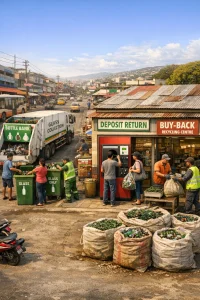
3. Deposit‑Return Schemes (DRS)
What it is
- Consumers pay a small deposit when buying beverage containers; deposit is refunded when they return the empty container to a collection point or reverse vending machine (RVM).
How it works
- Deposit registered at sale, refunded at return; scheme operator organises logistics and payments.
- Return points can be supermarkets, dedicated depots or automated machines.
Pros
- Consistently delivers very high return rates and very clean material by design.
- Strongly reduces litter and contamination.
- Creates clear value for each container → motivates careful handling and separation.
Cons (Global South considerations)
- Requires administrative setup, legislation and a managing body.
- Upfront costs for infrastructure (RVMs, IT systems) and running refunds.
- May disadvantage low‑income consumers temporarily unless deposit is small relative to income (but it’s typically a benefit as people reclaim money).
- Could conflict with livelihoods of informal collectors if not designed inclusively.
Practical tips / inclusive practice
- If rolling out, design with informal sector: allow reclaimers to collect deposits and return containers at depots for cash; register co‑ops for bulk returns.
- Start with targeted pilots (e.g., high‑value beverage bottles) before scaling up.
- Ensure accessible return points (not only RVMs in big supermarkets).
4. Buy‑backs and aggregation centres
What it is
- Small businesses or municipal centres that buy glass from collectors (households, informal collectors, traders) by weight.
How it works
- Collectors bring sorted or mixed glass and receive payment per kg; aggregator consolidates, sorts, and sells to processors.
Pros
- Direct economic incentive for collectors; supports livelihoods.
- Works well where informal collection networks already exist.
- Low tech, flexible, and scalable with demand.
Cons (Global South considerations)
- Price volatility and low prices can discourage collection or push collectors to low‑grade disposal.
- Risk of exploitation of informal workers if market power concentrated.
- Aggregation centres need space and basic equipment; may lack investment.
Practical tips / inclusive practice
- Encourage transparent weighing and pricing; consider cooperatives to strengthen bargaining power.
- Offer small upgrades: scales, tarpaulins, shaded sorting areas, PPE.
- Link aggregation centres with formal processors to secure steady demand and better prices.
5. Informal collection (reclaimers/waste pickers)
What it is
- Individuals or groups who collect recyclable glass from streets, bins, households, businesses and landfills; a major actor across many Global South cities.
How it works
- Reclaimers sell to middlemen, buy‑back centres or directly to recyclers; often operate independently or in loose networks.
Pros
- Very efficient at diverting material that formal systems miss.
- Provides livelihoods for marginalised people.
- Low public cost — reclaimers operate with minimal government funding.
Cons (Global South considerations)
- Often precarious, unsafe work with low pay and poor social protection.
- High risk of discrimination and eviction; children sometimes involved.
- Lack of recognition can lead to conflict with municipal services.
Practical tips / inclusive practice
- Recognise and integrate reclaimers: formalise cooperatives, provide PPE, secure working areas, training and fair contracts.
- Introduce local by‑laws that protect reclaimers’ right to collect while ensuring safety and hygiene standards.
- Use intermediary NGOs or community organisations to build trust between municipalities and reclaimers.
How collection method affects quality and recovery
- Source separation (kerbside sorted or DRS returns) → higher cullet quality (less contamination) → higher use in remelt and greater energy savings.
- Mixed collection or litter pickup → higher contamination (ceramics, stones, metals) → lower cullet share or need for costly sorting/processing.
- Frequent and convenient systems → higher participation → higher recovery rates.
- Formal systems that exclude informal collectors can reduce overall recovered volumes unless alternatives are provided.
Key simple metrics you can teach learners
- Recovery rate: proportion of glass containers collected for recycling out of total placed on market or discarded.
- Participation rate: proportion of households/businesses using the collection service.
- Cullet share: percentage of recycled glass used in new glass by mass.
- Contamination rate: percent of non‑glass material in collected loads.
- Collection cost per tonne: operational cost to collect/process a tonne of glass.
Choosing the right mix for a Global South context
Factors to weigh
- Urban form: dense cities favour kerbside or DRS; dispersed rural areas may need aggregation hubs.
- Existing informal sector: where reclaimers are active, design inclusive models rather than exclusionary formal services.
- Funding and political will: DRS needs legislation and managing bodies; kerbside needs municipal budgets.
- Market for cullet: processors need a steady supply and quality cullet, so collection must match processing needs (colour separation, low contamination).
- Behaviour and convenience: low‑cost, convenient options increase participation.
A typical pragmatic approach
- Start small: pilot bottle banks + aggregation centre + partnerships with reclaimers.
- Use buy‑backs to create immediate market links and livelihoods.
- Phase in more advanced measures (regulated DRS) once systems and funding are proven.
Short classroom activities (ready to use)
- Local map: students map where they can drop glass locally, who buys it, and where reclaimers operate. Discuss gaps.
- Roleplay: simulate a neighbourhood deciding between a bottle bank or kerbside service — weigh costs, convenience and jobs.
- Quick audit: collect a small sample of household glass for one week and measure contamination rate and weights; calculate simple recovery and participation estimates.
- Interview: arrange a short interview or video call with a local recycler or reclaimer co‑op and prepare 3 questions on inclusion and safety.
If you want, I can:
- Turn this into a 1‑page printable summary for learners.
- Create a short slide outline or activity sheet for the classroom.
- Draft a simple rubric for evaluating local collection systems.
Which would help you most next?