
-
Why glass matters: history and basics3 Topics
-
Where and how glass is used today3 Topics
-
State of glass waste and recycling3 Topics
-
Collection systems and actors3 Topics
-
Sorting, processing and making cullet3 Topics
-
Remelting, quality and markets3 Topics
-
Environmental, economic and policy aspects3 Topics
-
Practical implementation and teaching resources3 Topics
Participants 9


Policy instruments and incentives

travellingteacher256 April 13, 2026
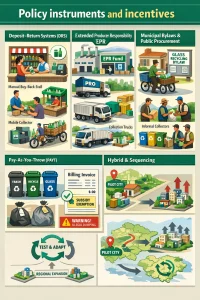
(How governments, producers and communities can boost glass recycling — practical notes for low‑resource settings)
Hi — in this topic we unpack the main policy tools that actually change what happens to glass bottles and jars after use. Short, practical and evidence‑based, with notes on whether a tool will work in a lower‑resource or Global South context and how to keep things equitable (especially for the informal sector).
Quick overview — the main instruments
- Deposit‑return systems (DRS, also called bottle bills)
Consumers pay a small deposit when they buy a drink; they get it back when they return the empty container. - Extended producer responsibility (EPR)
Producers/importers pay for some or all of the cost of collection, transport, sorting and recycling of their packaging. - Municipal bylaws and public procurement rules
Local councils set rules (e.g. mandatory separate collection, bans, minimum recycled content requirements, or procurement preferences for products with recycled glass). - Pay‑as‑you‑throw (PAYT) / user‑pays waste charges
Household/ business waste charges that vary with the amount of residual (non‑recycled) waste they generate.
Each tool has pros and cons. In practice you often combine instruments (hybrid models).
Deposit‑return systems (DRS)
What it does
- Creates a direct financial incentive for users to return glass containers.
- Can deliver very high return rates (many DRS reach 70–98% depending on design and enforcement).
Why it works
- Simple economic signal: a visible, recoverable value tied to each container.
- Makes separate collection predictable and supplies cleaner cullet for remelting.
Design choices that matter
- Which containers are covered? (All beverage types, only single‑use, or specific sizes.)
- Deposit value: must be large enough to motivate returns but affordable. Typically set as a fixed unit amount, not a percentage of price.
- Returns network: reverse vending machines, manual return points, retail take‑back, mobile collectors, buy‑back centres.
- Who runs it: producer‑run scheme, government operator, or a hybrid.
- Handling of unreturned deposits: used to finance operations or environmental programmes.
Suitability in low‑resource settings
- Pros: Clear incentive for collectors; can be designed to channel value to informal collectors/buyers; reduces litter.
- Challenges: Requires administrative capacity to run the scheme, initial set‑up finance, and a network for returns. Reverse vending machines are costly — manual return points and existing buy‑back centres are often better early options.
- Design tip: Use simple manual return sites + mobile collectors; register and pay informal collectors through local aggregation points; set deposit to be meaningful to low‑income users.
Equity & informal sector
- DRS can increase incomes for waste pickers if scheme design recognises and works with them (formal registration, collection points, vouchers or mobile payments).
- Risk: If large retailers capture returns exclusively (e.g. via machines), informal collectors can be excluded — mitigate via integration agreements.
Performance metrics to track
- Return/Redemption rate (% of sold containers returned)
- Cleanliness/contamination of returned glass
- Number of registered collection points and informal collectors included
Extended Producer Responsibility (EPR)
What it does
- Shifts financial (and sometimes operational) responsibility for end‑of‑life packaging from municipalities to producers/importers.
- Typically sets targets (e.g., % collection, recycling, minimum recycled content) and allows producers to comply individually or through producer responsibility organisations (PROs).
Why it works
- Internalises the cost of waste management into product prices, encouraging eco‑design, reuse, and higher recycling rates.
- Can mobilise private finance for collection infrastructure and awareness campaigns.
Design elements
- Clear targets and timelines (collection rates, recycling rates, recycled content).
- Transparent fee‑setting and reporting rules.
- Enforcement and sanctions for non‑compliance.
- Rules on inclusion of informal sector actors (payment for services they provide, formalisation pathways).
Suitability in low‑resource settings
- Pros: Flexible; can leverage producer funds where government budgets are limited. Useful where multiple packaging types exist.
- Challenges: Requires regulatory capacity to set and enforce targets; risk of weak monitoring and weak financial transparency.
- Design tip: Start with mandatory registration and basic targets, allow PROs to pilot collection schemes that explicitly subcontract informal collectors and small entrepreneurs.
Equity & informal sector
- EPR can be pro‑poor if schemes pay for collection services that informal pickers already provide, offer formal contracts, training and PPE, and avoid concentrating money with large recyclers only.
- Risk: If PROs favour large formal collectors, informal livelihoods may be harmed.
Performance metrics to track
- Producer compliance rate
- Volume of glass collected under EPR (t/year)
- Share of funds paid to small/local collectors vs large recyclers
Municipal bylaws and procurement
What it does
- Local governments can require separation of glass at source, set minimum recycling targets, ban certain disposal routes, or favour products with recycled content in procurement.
Why it works
- Local rules are close to implementation and can be tailored to local realities.
- Public procurement can create guaranteed demand for recycled glass (in construction, tiles, road aggregate, etc.).
Design notes
- Bylaws should be realistic (match available collection and processing capacity).
- Allow phased implementation, with clear compliance dates and assistance for informal collectors to register.
Suitability in low‑resource settings
- Pros: Low administrative cost if targeted (e.g., require separation in municipal buildings, markets, hospitals). Can be effective quickly.
- Challenges: Enforcement resources are limited; bylaws without collection systems are toothless.
- Design tip: Combine bylaws with practical support: starter grants for community collection points, training for municipal staff, simple signage and education.
Equity & informal sector
- Use bylaws to recognise and legitimise informal collectors (permit systems, designated collection times/areas).
- Public procurement can pay fair prices for cullet supplied by small aggregators.
Performance metrics to track
- Number of facilities complying with separation rules
- Volume of glass diverted due to procurement preferences
Pay‑as‑you‑throw (PAYT)
What it does
- Households/businesses pay for waste disposal based on the amount of residual waste they produce — incentivising recycling and source separation.
Why it works
- Creates a continuous economic incentive to reduce residual waste (and increase recycling).
Design choices
- Unit of charging (bag tag, bin size, weight).
- Exemptions or subsidies for low‑income households to avoid regressive impacts.
- Clear accessible recycling alternatives must exist or PAYT leads to illegal dumping.
Suitability in low‑resource settings
- Pros: Effective where billing/collection systems exist; can reduce waste volumes and increase recycling.
- Challenges: Requires administrative billing, and risks illegal dumping or harassment of informal collectors if not well designed.
- Design tip: Pair PAYT with safe, free or low‑cost recycling drop‑offs (or DRS/EPR funded collection) and provide subsidies or flat rates for low‑income households.
Equity & informal sector
- PAYT can reduce the demand for informal collection if households dispose illegally; better to integrate informal actors as authorised recyclers and create buy‑back points.
Performance metrics to track
- Residual waste per capita (kg/person/month)
- Recycling participation rates
- Incidence of illegal dumping or complaints
Hybrid models and sequence of reforms
Practical sequencing often works better than one big law. Suggested pathway for a low‑resource city/country:
- Map stakeholders (producers, informal collectors, recyclers, municipalities, retailers).
- Start small: municipal bylaws + public procurement to create demand for cullet.
- Introduce EPR with basic mandatory registration and reporting; allow PROs to pilot schemes.
- Pilot a deposit scheme in a city/for specific beverage categories using manual return points and buy‑back centres.
- Scale up DRS or strengthen EPR once logistics, finance and monitoring are proven.
Why this helps: pilots build public trust, prove business models, and create transitional income streams for informal collectors.
Inclusion checklist — keep it equitable and practical
- Recognise and map the informal sector early (who collects, where, how much do they earn?).
- Design payments and collection points that are reachable for informal collectors (local aggregation hubs, mobile payments).
- Avoid requiring expensive tech (reverse‑vending machines) as the only return option — use manual buy‑back points.
- Set deposit values that matter locally; consider inflation and exchange variability.
- Ensure small businesses and informal workers can register with minimal paperwork and low fees.
- Use part of unclaimed deposits or EPR fees to fund social measures (training, PPE, healthcare).
- Monitor social impacts (job numbers, earnings, gendered effects) as well as environmental KPIs.
Monitoring & simple KPIs (for educators and TVET learners)
Keep the indicators simple and actionable:
- Collection / recovery rate (%) — share of post‑consumer glass that’s collected for recycling.
- Return/redemption rate (%) — DRS specific.
- Cullet share (%) — share of recycled glass in furnaces.
- Contamination rate (%) — % of glass mixed with non‑glass or broken beyond use.
- Energy/CO2 savings estimates — use simple rules of thumb (see readings).
- Number of informal workers engaged / formalised — social indicator.
A simple data collection routine: daily collection weights at aggregation point, weekly counts of containers returned, monthly summary to municipal/producers’ portal.
Common pitfalls and how to avoid them
- Pitfall: Introducing PAYT without recycling options → illegal dumping.
Fix: Ensure accessible recycling/return options before billing changes. - Pitfall: High‑tech DRS only → excludes rural or low‑income users.
Fix: Mix manual return points and mobile collectors with a few machines in urban hubs. - Pitfall: EPR with no enforcement → fees paid but no collection improvements.
Fix: Transparent reporting, independent audits, and civil‑society oversight. - Pitfall: Schemes that displace informal incomes.
Fix: Explicitly integrate and compensate informal collectors; provide routes to formal contracts.
Short, practical case ideas you can use in a classroom or TVET setting
- Design a mini‑DRS pilot for a township: choose deposit value, decide 5 return points, estimate monthly recovered glass and incomes for collectors.
- Run an EPR role‑play: producers, local government and informal collectors negotiate how fees are spent.
- Make a KPI poster: students collect daily weights from a school canteen glass bin for a month and calculate recovery rate.
Suggested short readings and briefs (search terms and organisations)
Look up these accessible briefs and reports — they are good condensations of evidence and practical guidance:
- OECD — “Extended Producer Responsibility: A Guidance Manual for Governments” (search by title + OECD).
- UNEP — policy briefs on EPR and resource efficiency (search: “UNEP EPR policy brief glass packaging”).
- World Bank — “What a Waste” series and short briefs on municipal solid waste (search: “World Bank What a Waste EPR PAYT”).
- Reloop / Eunomia / Zero Waste Europe — short briefs on Deposit‑Return Systems (search: “Reloop deposit return briefing” or “Eunomia DRS briefing”).
- National/municipal case studies: search for “deposit return pilot South Africa”, “glass recycling Uganda case study”, or your country name + “EPR regulations glass” for local documents.
(These are generally brief, practical documents or have short executive summaries suitable for 1‑page teaching notes.)
Final tip — choose simplicity and integration
In low‑resource settings, start with simple, low‑cost interventions that plug into existing systems: use buy‑back centres, pay informal collectors fairly, create municipal procurement demand for cullet, and progressively add regulation (EPR or DRS) once capacity and stakeholder trust are built. Always measure both environmental outcomes (recovery rates, cullet share) and social outcomes (jobs, incomes, inclusion).
If you’d like, I can:
- Draft a 1‑page handout for learners summarising these instruments, or
- Create a short classroom exercise (DRS or EPR role play) with instructions and scoring. Which would be more useful?