
-
Why glass matters: history and basics3 Topics
-
Where and how glass is used today3 Topics
-
State of glass waste and recycling3 Topics
-
Collection systems and actors3 Topics
-
Sorting, processing and making cullet3 Topics
-
Remelting, quality and markets3 Topics
-
Environmental, economic and policy aspects3 Topics
-
Practical implementation and teaching resources3 Topics
Participants 9


Collection systems and actors

travellingteacher256 April 13, 2026
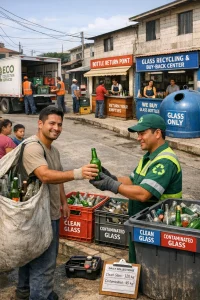
Think about the last glass bottle or jar you threw away. Did it go into a kerbside bin, a street‑side container, a shop return point — or into an informal collector’s bag? How that bottle moves from your hands into a recycling stream (or not) determines whether it becomes cullet for a new bottle, ends up in landfill, or is picked over by someone earning a living from waste.
This short lesson is practical and grounded: we look at the everyday systems that actually get glass from households and businesses to recyclers, who the main actors are (municipal services, private companies, and informal collectors), and how simple design choices shape both the quantity and quality of recovered glass. In the Global South context — where formal services are often limited and informal actors play a large role — understanding these systems is essential for designing inclusive, effective recycling solutions.
Why this matters
- Collection is the gatekeeper of glass recycling. High recovery rates and clean cullet start with good collection design.
- Different systems (kerbside, drop‑off, deposit‑return, buy‑back centres, informal collection) have very different costs, recovery levels and contamination risks.
- Who collects matters: integrating informal collectors can improve livelihoods and recovery but needs careful planning to protect rights and safety.
- Simple metrics (recovery rate, cullet share, contamination level, collection cost per tonne) let you assess and compare systems without needing technical expertise.
What you’ll be able to do after this lesson
- Recognise common glass collection methods and where they work best.
- Explain the roles and motivations of municipal, private and informal actors.
- Use a few simple metrics and questions to judge how well a local collection system is likely to perform and to spot opportunities for improvement and inclusion.
How to use this lesson
- Read the short explanations and real‑world examples.
- Think about the system in your town or school: who collects glass, where does it go, and what happens to it next?
- Try the quick activity at the end: map one local collection route and note the main actors and likely weak points.
Ready? Let’s start with how the most common collection methods actually work in practice.