
-
Why glass matters: history and basics3 Topics
-
Where and how glass is used today3 Topics
-
State of glass waste and recycling3 Topics
-
Collection systems and actors3 Topics
-
Sorting, processing and making cullet3 Topics
-
Remelting, quality and markets3 Topics
-
Environmental, economic and policy aspects3 Topics
-
Practical implementation and teaching resources3 Topics
Participants 9


Environmental, economic and policy aspects

travellingteacher256 April 13, 2026
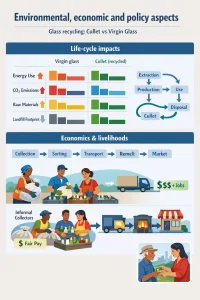
Welcome! In this lesson we step back from the technical side of glass recycling (sorting, remelting, quality) and look at the bigger picture: what happens to the planet, people and markets when we choose to make new glass from raw materials versus re‑using cullet. We’ll also explore practical policy and business tools that actually boost recycling — and how to do that in ways that are fair to informal collectors, small businesses and vulnerable workers common across the Global South.
Why this matters
- Using cullet instead of virgin raw materials cuts energy use and greenhouse‑gas emissions, reduces pressure on sand and soda supplies, and lowers landfill needs.
- Glass recycling creates value chains: jobs, small enterprises and recyclable commodity flows — but those benefits are uneven unless systems are designed to include informal workers.
- Policy choices (from deposit‑return schemes to municipal collection contracts) shape how much glass is recovered and who benefits. The right instruments can turn waste into steady income and environmental gains.
How this lesson will help you
You’ll get a practical, evidence‑based view of the life‑cycle advantages of cullet, an understanding of the economics and livelihoods tied to glass recycling, and a toolkit of policy and business measures that improve recovery rates and outcomes equitably. The emphasis is non‑technical and transferable — you’ll come away able to explain simple metrics (recovery rate, cullet share, basic energy savings), assess trade‑offs, and sketch inclusive interventions for your community or classroom.
Topics ahead
-
Life‑cycle impacts and benefits
We’ll compare the environmental footprints of virgin glass production versus using cullet — energy, emissions and resource use — and learn how to interpret simple life‑cycle messages so learners can see real-world impacts. -
Economics, jobs and livelihoods
We’ll look at where value and jobs are created in glass systems (collection, sorting, transport, remelt), the role of informal actors, and simple ways to evaluate local economic benefits and equity issues. -
Policy instruments and incentives
We’ll review practical tools — deposit‑return schemes, extended producer responsibility, municipal procurement, standards and fiscal incentives — and discuss how to design and combine measures that raise recovery rates while protecting and empowering informal workers.
Quick outcomes
By the end of this lesson you’ll be able to:
- Explain the main environmental benefits of using cullet in plain language.
- Describe the key economic roles glass recycling plays in local economies and why inclusion matters.
- List and compare practical policy tools and suggest equitable options for a specific context.
Let’s get started — we’ll begin with the life‑cycle story of glass and why cullet makes a difference.