
-
Why glass matters: history and basics3 Topics
-
Where and how glass is used today3 Topics
-
State of glass waste and recycling3 Topics
-
Collection systems and actors3 Topics
-
Sorting, processing and making cullet3 Topics
-
Remelting, quality and markets3 Topics
-
Environmental, economic and policy aspects3 Topics
-
Practical implementation and teaching resources3 Topics
Participants 9


Quality standards and market value

travellingteacher256 April 13, 2026
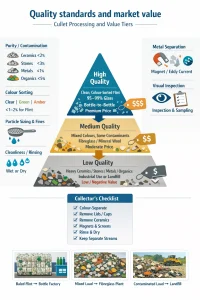
When we talk about cullet (waste glass ready for recycling), “quality” is what decides who will buy it, what it can be used for, and how much it’s worth. Here’s a practical, non‑technical guide you can use with learners or in training sessions.
Why buyers care
- Glass that’s clean, correctly sized and colour‑sorted melts predictably, reduces furnace problems and makes high‑value, food‑grade containers possible.
- Contaminants (ceramics, stones, metals, organics, wrong colours) cause defects, damage furnace linings or increase processing costs.
- Buyers set specs to protect their furnaces, final product quality and regulatory compliance (food safety, strength, colour consistency).
Typical specification areas (what buyers look for)
- Purity / contamination limits
- Most container‑glass buyers want very high glass purity. Typical expectations are in the range of about 95–99% glass by weight (i.e., 1–5% non‑glass contaminants), with the tighter end required for bottle‑to‑bottle recycling.
- Critical contaminants: ceramics/porcelain/stones (cause defects and refractory wear), metals (iron caps, aluminium), and organics (food residues, paper, adhesives). Buyers often require ceramics and hard stones to be virtually absent (very low single‑digit percentages), and low metal content (magnetically separated).
- Note: exact thresholds vary by buyer and plant; some are stricter than others.
- Colour sorting
- Clear (flint) cullet is the most valuable because it can become any colour of bottle (including clear). Even small amounts of green/amber in flint can downgrade the batch. Typical tolerances for cross‑colour contamination are low (often <1–2% for flint).
- Green and amber (brown) streams are more tolerant of small contamination, but colour purity is still important for consistent final products.
- Particle sizing and fines
- Buyers specify size ranges (e.g., minimum and maximum particle sizes) suited to their melting and handling systems. They also limit “fines” (very small particles, dust) because fines can cause dust issues, reduce furnace throughput and affect melting behaviour.
- Typical practice: screen out a certain percentage of fines (exact limits vary).
- Cleanliness / organic residues
- Food residues, labels, adhesives and damp material are undesirable. Buyers want dry material with minimal organic contamination because organics create foaming, gases and can create more waste (skimming). Rinsing and drying often improve value.
- Metal and ceramic limits
- Iron and non‑ferrous metals are usually removed before sale; magnetic separation and eddy‑current separators are common. Ceramics and stones must be minimised because they don’t melt with soda‑lime glass and cause defects.
How quality influences price
- Higher quality = higher price. Clean, colour‑sorted cullet for bottle‑to‑bottle applications commands the top prices because it replaces more virgin raw materials and saves energy.
- Mixed or lightly contaminated cullet (mixed colours, some non‑glass contaminants) is lower value and will typically be sold at a discount or redirected to lower‑value applications.
- Very low quality (high contamination, mixed inert waste) may have little market value and can even cost to dispose of.
- Buyers typically price cullet relative to the costs they save: energy, raw materials, and furnace throughput. So if a clean cullet lot reduces furnace energy and batch raw materials significantly, the buyer will pay more.
Which markets accept what quality
- Bottle‑to‑bottle (closed loop): requires the highest quality — high glass purity, strict colour separation, very low contaminants and often documentation for food‑contact safety. Biggest value.
- Bottle‑to‑container (open loop, other bottles): similar quality requirements but sometimes slightly more flexible depending on end use.
- Fibreglass and mineral wool: can accept mixed colours and some lower levels of contamination if chemically compatible and processed correctly. Still requires removal of large ceramics/metals and most organics. Demand is sensitive to chemical composition in some cases. Value is usually lower than container markets but higher than aggregate.
- Other industrial uses (e.g., glassphalt, sandblasting media, cement flux): tolerate lower quality and mixed colours. These are low‑value markets but useful when container markets are not available.
- Landfill or waste: worst outcome — no value and environmental cost.
Practical examples (to use with learners)
- A bale of well‑sorted, rinsed, flint cullet with negligible ceramic and metal contamination → likely sold to bottle manufacturers at a premium.
- A mixed‑colour, lightly contaminated load with some metal bits and fines → likely sold to fibreglass makers or mixed‑glass processors at a moderate price.
- A heavily contaminated load with ceramics, stones and organics → may be rejected, sold for low‑value uses, or landfilled.
How specs are checked (non‑technical)
- Visual inspections and random sampling.
- Sieving to check particle size and fines.
- Magnets and metal detectors to quantify metal content.
- Simple lab checks or buyer audits for chemical compatibility or food‑contact requirements if needed.
Tips for improving value at collection and sorting level
- Source‑separate by colour at point of collection (clear, green, brown) — this adds big value.
- Remove lids, caps and large non‑glass items before crushing/transport.
- Rinse bottles where practical and keep material dry. Even simple rinsing reduces organics and increases value.
- Educate collectors and the public: clear signage makes a big difference.
- Use basic mechanical separation: magnets for ferrous metals, screens to remove oversized items and fines, and optical sorting if available.
- Remove ceramics, stones and heat‑resistant glass (like Pyrex) — these cause trouble in furnaces.
- Keep separate streams for material destined for food‑grade reuse versus industrial use.
Quick checklist for sorting crews and small recyclers
- Colour separation: flint / green / amber.
- No lids/caps; remove metal closures.
- No ceramics, stones, light bulbs or heat‑resistant glass.
- Low fines and dry material.
- No large amounts of paper, food wastes or adhesives.
Closing note
Quality is the single most important factor that determines whether cullet becomes high‑value bottles or low‑value aggregate. Simple steps at collection and sorting — colour separation, basic cleaning, removing metals and ceramics — dramatically increase market options and price. When you teach this topic, focus on the easy wins that communities and small businesses can apply immediately.