
-
Why glass matters: history and basics3 Topics
-
Where and how glass is used today3 Topics
-
State of glass waste and recycling3 Topics
-
Collection systems and actors3 Topics
-
Sorting, processing and making cullet3 Topics
-
Remelting, quality and markets3 Topics
-
Environmental, economic and policy aspects3 Topics
-
Practical implementation and teaching resources3 Topics
Participants 9


Remelting, quality and markets

travellingteacher256 April 13, 2026
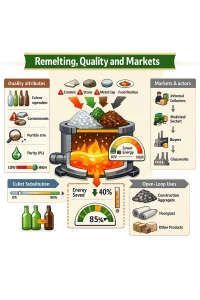
Welcome — this lesson takes you inside the hot heart of glass recycling: the furnace — and shows why what goes into the furnace (the cullet) and how clean it is, makes all the difference to energy use, product quality and whether glass comes back as glass in a true closed loop.
We’ll keep things practical and non‑technical. Think of the furnace as a big recycling oven: broken bottles and jars (cullet) are fed in, melted down and reshaped into new containers. The more clean cullet in the mix, the less raw material and energy the furnace needs. But not all cullet is the same — colour, contaminants (ceramics, stones, metal caps, food residues) and particle size all affect whether the melted glass is suitable for new food‑grade bottles or has to be diverted to other uses. That’s where quality standards, market specifications and value chains come in.
In this lesson you’ll explore three linked topics:
- Remelting and closed‑loop recycling — what actually happens in the furnace, why cullet melts faster and cooler, and how substituting cullet for raw materials saves energy and cuts emissions.
- Quality standards and market value — the common specifications buyers and furnaces expect, the kinds of contamination that cause problems, and why higher‑quality cullet earns higher prices and better outcomes.
- End markets and value chains — the difference between closed‑loop (bottle‑to‑bottle) and open‑loop uses, who the buyers are, and how market demand and supply shape recycling outcomes.
What you’ll be able to do by the end of the lesson
- Explain, in simple terms, how cullet substitution lowers furnace energy needs and supports closed‑loop recycling.
- List the main quality attributes that determine cullet value and why they matter to producers.
- Identify typical end markets for recycled glass and how quality and colour separation influence whether glass returns to containers or heads to other uses.
Quick practical note for educators: visual aids (photos of cullet grades, a short animation of melting, or a visit to a local glassworks) make these concepts click quickly for TVET and high‑school learners. We’ll keep the focus on systems, simple metrics (like cullet share and recovery rates) and inclusive practice — recognising the role of both formal systems and informal collectors in getting quality cullet into the furnace.