
-
Why glass matters: history and basics3 Topics
-
Where and how glass is used today3 Topics
-
State of glass waste and recycling3 Topics
-
Collection systems and actors3 Topics
-
Sorting, processing and making cullet3 Topics
-
Remelting, quality and markets3 Topics
-
Environmental, economic and policy aspects3 Topics
-
Practical implementation and teaching resources3 Topics
Participants 9


Sorting and colour separation

travellingteacher256 April 13, 2026
Lesson Progress
0% Complete
Sorting and colour separation
Why this matters (short version)
- Glass cullet needs to be the right colour for many remelt uses. Clear (flint), amber (brown) and green glass are the main commercial colour groups. If colours are mixed, the value and utility of the cullet drops — it can’t be used for many new containers and may only be suitable for lower‑value uses (construction aggregate, tiles, etc.).
- Clean, single‑colour cullet saves energy at the furnace, reduces waste, improves melt quality and increases revenue for collectors and recyclers. For bottle‑to‑bottle recycling you usually need very high colour purity and low contamination — check your local furnace/melter specifications.
A simple process flow for colour separation (practical)
- Incoming inspection and coarse removal
- Quick visual check of incoming loads.
- Remove big contaminants first: sacks, stones, wooden pallets, large metal items.
- Pre‑clean / sorting table
- Place on a sloped hand‑sorting table or flat surface.
- Manual removal of obvious contaminants (plastics, caps, corks, ceramics, light bulbs).
- Primary colour sort (manual)
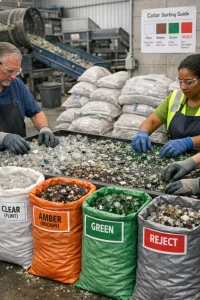
- Pickers sort into colour‑coded bins/sacks: clear, amber, green, and “reject”.
- Do a fast second pass to catch mistakes.
- Mechanical pre‑processing (optional / low‑cost)
- Trommel or screen to remove fines and paper.
- Magnetic separators for ferrous metal.
- Eddy current separators for non‑ferrous (if available).
- Simple air or water bath to remove light contaminants (labels, small plastics).
- Secondary hand‑picking (post‑crush)
- After crushing, pass cullet across picking belts/tables to remove remaining contaminants (ceramics, stones, bulbs, heat‑resistant glass).
- Final grading and storage
- Store each colour separately, labelled with date and quality notes.
- Keep rejects separate for alternate markets or safe disposal.
Manual sorting — best practice tips
- Use colour‑coded sacks or bins and clear signage so pickers know exactly where each colour goes.
- Train pickers with simple colour charts and hands‑on practice. Use real examples of problem items (amber‑tinted green bottles, painted glass) so they learn edge cases.
- Work in good daylight or provide uniform lighting (avoid colour distortion lamps).
- Keep the workstation at waist height to reduce strain and speed up sorting.
- Encourage teamwork: one person does a first quick sort, another does a slower quality check.
- Rotate tasks to reduce repetitive strain injuries.
- Pay fairly and recognise informal pickers — inclusion improves quality.
Why colour matters (details)
- Colour affects what a smelter can make: clear (flint) is needed for clear bottles and some optics; amber is valuable for beer/medicine bottles; green for soft drink and wine bottles.
- Even small amounts of unintended colour can tint a whole melt, creating off‑colour batches that may be rejected or downgraded.
- Many container manufacturers specify minimum single‑colour purity and maximum contamination levels — for bottle‑to‑bottle recycling these specs can be strict (high purity and low non‑glass contaminants).
Common contamination problems and how to fix them
- Ceramics and heat‑resistant glass (Pyrex): These have different melting behaviour and can cause scum or defects.
- Fix: Train pickers to spot and remove; use a secondary hand‑pick station after crushing.
- Light bulbs and fluorescent tubes: Contain coatings, metal caps and sometimes mercury (hazard).
- Fix: Keep bulbs out of bottle collections; run awareness campaigns; have a safe disposal stream for lamps.
- Window glass and mirrors: Different composition and coatings.
- Fix: Separate at collection point; communicate to households what to put in bottle collections.
- Metal caps, discs, and rings
- Fix: Use magnets and eddy current separators; hand‑pick larger items.
- Paper labels and glue
- Fix: Soak or wet‑wash in tanks (if water is available and managed), or use abrasion/air knives and sieves to remove fines; ensure wastewater is handled responsibly.
- Plastic and PVC contamination
- Fix: Manual removal; flotation tanks can separate lighter plastics from glass cullet.
- Stones, car glass, and ceramics
- Fix: Mechanical screening and hand‑picking of heavy rejects; crush and sieve to separate fines.
Mechanical sorting options (from low‑cost to advanced)
- Low‑cost / entry level
- Trommel / vibrating screen to remove fines, paper and small debris.
- Magnets to remove ferrous metal.
- Simple conveyor + hand‑picking table for quality control.
- Water soak tanks to loosen labels (requires wastewater plan).
- Mid‑level
- Air classifiers for light contaminants.
- Eddy current separators for aluminium.
- Optical sorters (basic models) to help colour separation — still require good feed quality and maintenance.
- High‑end (capital‑intensive)
- High‑speed optical sorters that separate by colour and remove glass types; cameras + sensors.
- Combined sensor systems (NIR, colour cameras) with automated reject gates.
Low‑cost practices that dramatically improve quality (practical checklist)
- Colour‑coded collection at source: clear, green, amber sacks/boxes.
- Public information (posters, radio messages, local language flyers) showing which items belong where.
- Incentivise purity: small price premium for clean, single‑colour loads.
- Simple training sessions for collectors/pickers: practice sorting, show common contaminants.
- Use daylight or consistent LED lamps at sorting tables to reduce colour errors.
- Maintain a “reject” stream and a plan for safe disposal or alternative use (e.g., construction aggregate).
- Periodic quality checks and feedback loops: check a sample from each load and give results to collectors.
- Provision of basic PPE and covered sorting areas to keep cullet dry and clean.
Quality targets and simple metrics to monitor
- Colour purity: aim for as close to 100% single‑colour as possible; many container remelters expect very high purity — check buyer specs.
- Non‑glass contaminants: aim <1–3% by weight for container‑grade cullet (local goals may differ; ask mills).
- Recovery rate: monitor the percentage of collected glass that becomes marketable cullet (post‑sort). This helps track improvements.
- Cullet share: track how much cullet (by colour) goes into remelt versus rejects.
Note: exact acceptable levels vary by furnace and product. Always confirm local smelter specifications.
Health, safety and inclusive practice
- Always provide gloves, safety glasses and closed shoes; consider cut‑resistant gloves.
- Ensure adequate ventilation — dust can be a hazard.
- Protect informal workers: fair pay, training on hazards (broken glass, heavy lifting, chemical risks), access to health services.
- Consider gender and accessibility: design sorting stations for shorter/longer reach; create flexible hours; support childcare if needed.
Quick troubleshooting guide
- Problem: Too much amber in clear loads → retrain collectors, change collection signage, add a colour quick‑check at the depot.
- Problem: High metal content → install or repair magnets/eddy current, add a pre‑pick station.
- Problem: Streaks/black scum in the melt → likely ceramics/heat‑resistant glass contamination; increase post‑crush hand‑picks and educate collectors about forbidden items.
- Problem: Labels and glue causing flotation issues → use soak tanks or mechanical washers and manage wash water responsibly.
Summary – practical priorities for small centres
- Start with good collection design: colour‑coded bags/bins and simple public messaging.
- Use a basic hand‑sorting table with good light and a second quality check.
- Remove metals and large contaminants early (magnets, manual).
- Invest in a small trommel and conveyor if budgets allow.
- Keep each colour stored separately and track basic quality metrics.
- Train and respect your workforce — quality improves when people are motivated and safe.
If you want, I can:
- Draft a one‑page colour‑separation poster you can print for collectors and pickers.
- Make a short checklist for equipment and simple cost‑estimates suitable for small recycling centres.