
-
Why glass matters: history and basics3 Topics
-
Where and how glass is used today3 Topics
-
State of glass waste and recycling3 Topics
-
Collection systems and actors3 Topics
-
Sorting, processing and making cullet3 Topics
-
Remelting, quality and markets3 Topics
-
Environmental, economic and policy aspects3 Topics
-
Practical implementation and teaching resources3 Topics
Participants 9


Formal vs informal sectors

travellingteacher256 April 13, 2026
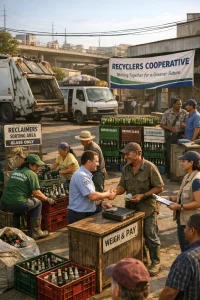
This topic looks at how municipal/private waste services and informal waste pickers (also called reclaimers, waste pickers, catadores, etc.) interact around glass collection — the common tensions that come up — and practical ways to include informal workers in a fair, safe and effective recycling system.
Speak plainly: the informal sector is not a “problem” to be erased. It’s a major source of material recovery and livelihoods across the Global South. But without recognition and sensible system design, everyone loses — collectors, municipalities, recyclers and the environment.
Who does what? Quick definitions
- Formal sector: municipal services, licensed private collectors, formal buy‑back centres and recycling companies. They operate under contracts, permits and official rules.
- Informal sector: independent waste pickers who collect recyclables directly from streets, bins, dumpsites or kerbside. Often unregistered and working without formal employment protections.
Informal workers commonly do the first and cheapest step of glass recovery: finding, sorting and transporting glass to local aggregators or dealers.
Typical interactions between sectors
- Complementary: informal pickers supply high‑quality, source‑separated material (like clean bottles) to aggregators, which then sell to formal recyclers.
- Competitive/tensioned: formal collectors may view reclaimers as “interfering” or losing revenue; reclaimers may be excluded from recycling contracts or blamed for contamination.
- Co‑existence: in many cities both systems run in parallel — reclaimers doing doorstep/dump/transfer‑station recovery while formal services handle bulk collection and transport.
Common tensions and their causes
-
Access to materials
- Municipal services close transfer stations or lock collection points, preventing reclaimers from accessing recyclables.
- Private contracts may monopolise routes without provisions for reclaimers.
-
Income and pricing
- Reclaimers often get low prices from middlemen; formal recyclers want steady low‑cost supplies.
- Price volatility (demand/commodity markets) hits reclaimers first.
-
Safety and working conditions
- Reclaimers face injury, exposure to biohazards, harassment, and lack of protective gear.
- Child labour and gendered vulnerabilities may be issues.
-
Legal status and harassment
- Lack of recognition can lead to harassment, confiscation of material, fines or eviction from dumpsites.
-
Material quality and contamination
- Formal recyclers complain about contamination; reclaimers argue they collect cleaner material when allowed access to households.
-
Social stigma and exclusion
- Waste picking is frequently stigmatised, affecting dignity and access to services.
Why inclusion matters (short)
- Increases recovery rates and material quality.
- Saves municipal costs (less waste to landfill).
- Secures livelihoods and reduces poverty.
- Supports circular economy goals and social justice.
Practical approaches to inclusion (what actually works)
These are pragmatic steps municipalities, private firms and NGOs can take. Most are low‑tech and replicable.
-
Recognise and map
- Map where waste pickers work (routes, dumpsites, transfer stations) and how many there are.
- Register reclaimers voluntarily to understand numbers and needs.
-
Open dialogue and participatory planning
- Establish a forum with reclaimers, municipality, recyclers and civil society.
- Use simple memoranda of understanding (MoUs) to set expectations.
-
Formal agreements and contracts
- Grant reclaimers access rights to specific transfer stations or curbside materials.
- Include reclaimers in municipal contracts (subcontracting, inclusion clauses, minimum purchase of source‑separated material).
-
Cooperatives and associations
- Support reclaimers to form cooperatives or savings groups so they can negotiate better prices, pool transport and reduce middlemen.
- Cooperatives can run buy‑back centres or supply formal recyclers directly.
-
Payment and fair pricing
- Ensure transparent price mechanisms based on market rates and simple weight/volume measurement.
- Where possible, provide regular (weekly/biweekly) payments rather than casual cash for small loads.
-
Infrastructure design
- Design transfer stations and MRFs with safe, dedicated areas for reclaimers to sort and sell material.
- Locate drop‑off points and bottle banks in safe, accessible places.
-
Health, safety and PPE
- Provide basic training, gloves, boots, first‑aid and hygiene measures.
- Offer vaccinations and child‑safety awareness where needed.
-
Capacity building
- Train reclaimers on sorting for quality, basic bookkeeping, and occupational safety.
- Support business skills for co‑ops (pricing, logistics).
-
Social protection and credit
- Link reclaimers to microfinance, health services or municipal ID programmes for better access to benefits.
- Consider “living wage” or social grants where recycling incomes are insufficient.
-
Data, monitoring and feedback
- Track metrics: tonnes collected, number of reclaimed households, incomes, contamination rates.
- Use simple dashboards and regular feedback meetings.
-
Integrate into policy and DRS
- When introducing deposit‑return schemes (DRS) or pay‑as‑you‑throw, protect reclaimers’ rights and build mechanisms for their participation so they’re not excluded.
What inclusion can look like — short examples
- Cooperatives selling directly to recyclers for higher prices and regular volumes (common in parts of Brazil and India).
- Municipal transfer stations with designated reclaimers’ sorting areas and a scale/payment counter.
- Buy‑back centres run by co‑ops with business support from NGOs or local government.
- City policies that recognise reclaimers in waste management plans and require contractors to work with them.
Cities such as Belo Horizonte (Brazil), Bogotá (Colombia), Pune (India) and several South African metros have examples of reclaimers being formally recognised or organised into cooperatives — each approach tailored to local context.
Practical checklist for a municipality or recycler starting inclusion work
- Map reclaimers and routes.
- Convene a multi‑stakeholder meeting (reclaimers, recyclers, unions, NGOs).
- Draft a simple MoU covering:
- Access rights and times
- Price/payment mechanism
- Health & safety responsibilities
- Grievance mechanism
- Pilot a dedicated reclaimers’ spot at a transfer station or MRF.
- Train and equip a pilot group (PPE + sorting training).
- Monitor: tonnes collected, income changes, contamination rates, safety incidents.
- Adjust and scale.
Simple contract elements to protect fair livelihoods
- Recognition clause: names/IDs of the reclaimers or co‑op.
- Access clause: where and when they can collect/sort.
- Payment clause: price formula, weighing method, payment frequency.
- Safety clause: provision of PPE/training and responsibilities.
- Dispute resolution: simple process and contact person.
- Review clause: periodic review every 3–6 months.
Metrics you can use in a course or class exercise
- Number of reclaimers integrated (headcount or households).
- Tonnes of glass recovered by reclaimers per month.
- Average income per reclaimer from glass (%) before vs after inclusion.
- Contamination rate (glass with non‑glass/ceramics) — simple % of loads rejected.
- Number of safety incidents reported.
These are easy to measure locally and great for classroom activities.
Risks and pitfalls to avoid
- Tokenism: “registering” reclaimers without real access or income improvements.
- Displacement: introducing DRS or private contracts that cut reclaimers out of the value chain.
- Over‑reliance on NGO funding for sustainability. Aim for business models that pay.
- Ignoring gender: women and children often make up large parts of reclaimers — design with their safety and time constraints in mind.
Short talking points for educators/learners
- Informal collectors do much of the glass recovery in many Global South cities — include them, don’t criminalise them.
- Inclusion boosts recovery, improves material quality and creates fairer livelihoods.
- Practical steps are low‑tech: mapping, dialogue, simple MoUs, co‑op support and safety measures.
- Measure results: tonnes recovered, incomes improved, contamination down.
If you want, I can draft:
- A one‑page handout for learners summarising the checklist and contract template.
- A simple classroom exercise (role play) where students negotiate a MoU between a city and a reclaimers’ cooperative.