
-
Why glass matters: history and basics3 Topics
-
Where and how glass is used today3 Topics
-
State of glass waste and recycling3 Topics
-
Collection systems and actors3 Topics
-
Sorting, processing and making cullet3 Topics
-
Remelting, quality and markets3 Topics
-
Environmental, economic and policy aspects3 Topics
-
Practical implementation and teaching resources3 Topics
Participants 9


What glass is (key definitions)

travellingteacher256 April 13, 2026
Lesson Progress
0% Complete
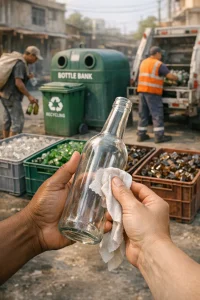
Quick, plain‑language definitions you can use in a lesson or on a handout. Short, practical — with a note on why each term matters for glass recycling in the Global South.
Glass
- Plain definition: Glass is an amorphous (non‑crystalline), inorganic solid made mostly from silica (sand) together with other minerals (soda ash, limestone, and small amounts of additives).
- What that means simply: unlike metals or crystals, glass has no regular internal structure — it behaves like a very stiff liquid that has been frozen in place.
- Why it matters for recycling: glass can be melted and re‑formed many times without losing quality if it’s kept free of the wrong things (contaminants).
Cullet
- Definition: Cullet is broken or waste glass used as feedstock for new glass. There are two types:
- Post‑consumer cullet = bottles and jars collected after consumer use.
- Process cullet = in‑plant scrap from manufacturing.
- Why it matters: adding cullet lowers the temperature needed to melt glass, saving energy and cutting emissions. The higher the cullet share in the furnace batch, the greater the benefits.
Closed‑loop recycling
- Definition: Reusing a material to make the same kind of product again — for glass, usually bottle‑to‑bottle or jar‑to‑jar.
- Example: Collected beverage bottles are cleaned, sorted by colour and remelted into new beverage bottles.
- Why it matters: closed‑loop keeps material value high and reduces the need for virgin raw materials and energy.
Collection systems
- Definition: The organised ways we gather waste glass from households and businesses so it can be recycled.
- Common types:
- Kerbside collection (bins picked up at homes)
- Bottle banks / drop‑off points
- Deposit‑return schemes (DRS) / payback for returned bottles
- Buy‑back centres and transfer stations
- Informal collection (see below)
- Why it matters: good collection systems reduce contamination, raise recovery rates and make recycling economically viable.
Contamination
- Definition: Any material in the glass stream that shouldn’t be there — e.g., food residue, ceramics, stones, metals, certain heat‑resistant glass (borosilicate), or wrong colours.
- Types and impacts:
- Organic contamination (food, liquids) can cause processing issues and smells.
- Non‑glass items (ceramics, stones, metals) can damage furnaces and reduce product quality.
- Mixed glass colours may reduce the value of cullet for clear‑glass production.
- Why it matters: contamination reduces the usable cullet share, raises sorting costs, and can force recyclers to downcycle or send material to landfill.
Formal vs informal sectors
- Formal sector:
- Definition: registered businesses and municipal services that collect, sort, process and trade recyclables within regulated channels.
- Strengths: better equipment, consistent quality control, access to markets and finance.
- Informal sector:
- Definition: independent collectors, itinerant buyers, waste pickers and small-scale traders who salvage materials from households, dumpsites and streets.
- Strengths: flexible, cost‑effective collection in areas formal systems don’t reach; important livelihoods.
- Why it matters: both sectors are vital in the Global South. Inclusive recycling strategies that recognise and integrate informal workers often increase recovery rates and social equity.
Circular economy
- Definition: An economic model that keeps materials in use for as long as possible, extracts maximum value from them, and then recovers and regenerates products and materials at the end of their life.
- For glass: designing for refill/reuse and high cullet‑share remelting are circular practices.
- Why it matters: moving from “take‑make‑dispose” to circular systems reduces resource demand, saves energy and creates local jobs.
Life‑cycle impacts
- Definition: The environmental effects of a product over its whole life — from raw material extraction, production and transport, through use, to disposal or recycling.
- For glass recycling:
- Virgin production (from sand and raw materials) requires more energy and emits more CO₂ than using cullet.
- Transport and collection add emissions; proximity of recycling facilities matters.
- End‑of‑life landfilling or littering causes resource loss and local environmental harm.
- Why it matters: life‑cycle thinking shows where recycling brings the biggest benefits (e.g., energy saved in melting, less mining of raw materials) and where systems need improvement (e.g., reducing transport distances, avoiding contamination).
Quick teaching tip
- Use a real bottle to show students: point out label (contaminant risk), colour, and talk through how it would move from household to collection point to furnace. Local examples make these definitions stick.
If you want, I can turn this into a one‑page printable handout or a simple slide for teachers.