
-
Why glass matters: history and basics3 Topics
-
Where and how glass is used today3 Topics
-
State of glass waste and recycling3 Topics
-
Collection systems and actors3 Topics
-
Sorting, processing and making cullet3 Topics
-
Remelting, quality and markets3 Topics
-
Environmental, economic and policy aspects3 Topics
-
Practical implementation and teaching resources3 Topics
Participants 9


Historical development and societal role of glass

travellingteacher256 April 13, 2026
Lesson Progress
0% Complete
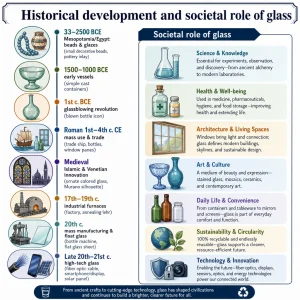
Let’s take a quick, friendly stroll through the history of glass — from accidental beads and small vessels to the glass we see in phones, cars and windows today — and why that long story still matters for glass recycling in the Global South.
A short timeline: how glass developed
- ~3500–2500 BCE — Early beads and glazes: The earliest evidence of glass comes from Mesopotamia and ancient Egypt as small beads, glazes on pottery and inlays. These were precious, decorative items rather than everyday materials.
- ~1500–1000 BCE — Early glass vessels: By the Late Bronze Age and early Iron Age, people were making simple glass containers and casting glass objects in the eastern Mediterranean and Levant.
- 1st century BCE — Glass blowing revolution: The invention of glass blowing in the Levant (Syro-Palestine) transformed production. Blown glass made lighter, thinner and cheaper containers possible and allowed a rapid spread of glassware across the Roman Empire.
- Roman period (1st–4th c. CE) — Mass use and trade: Romans used glass widely for bottles, jars, window panes in public buildings and small household items. Glass containers became a traded commodity across the empire.
- Medieval period — Islamic and Venetian innovation: Islamic glassmakers preserved and improved techniques (colour, luster); later Venetian (Murano) glassmakers developed high-quality clear glass and specialised crafts that shaped European styles.
- 17th–19th centuries — Industrial beginnings: Advances in furnace technology and demand for scientific glassware and window glass increased. Glass gradually moved from artisan to industrial production.
- 20th century — Mass manufacturing and new types: Bottle machines, float glass for windows (Pilkington process, 1959), tempered and laminated safety glass, and specialised glasses (borosilicate for heat resistance) became common.
- Late 20th–21st century — High-tech glass: Optical glass, fibre optics, display glass for phones/tablets, photovoltaic (solar) glass and advanced coatings have made glass central to communications and energy systems.
How glass shaped trade, storage and hygiene
- Storage and trade: Glass containers (bottles, amphorae, jars) protected and standardised the transport of oils, wine, medicines and perfumes. Glass helped enable longer-distance trade because it’s impermeable and inert — flavours and contents stay intact.
- Food preservation and safety: Unlike some porous ceramics or wooden containers, glass doesn’t react with food or leach chemicals (for typical soda‑lime glass). This made it valuable for storing food, medicine and chemicals — a big step for public health and commerce.
- Hygiene and medicine: Transparent, non-porous containers enabled sterile storage of medicines, vaccines and chemicals. Scientific glassware underpinned laboratory work and modern medicine.
- Visual culture and status: Clear and coloured glass were luxury goods for centuries, used in art, religious objects and architecture. Window glass in public buildings changed light, comfort and construction practices.
- Urbanisation and architecture: Large-scale window glass altered building design, hygiene (easier to clean), daylighting and visual comfort inside public and private buildings — important in growing towns and cities.
Glass and technology: why it became indispensable
- Optics and light: Glass is essential for lenses, microscopes, telescopes and cameras, which drove scientific progress.
- Communications: Fibre‑optic glass fibres enabled the global internet backbone.
- Electronics and displays: Chemically engineered glass is used in smartphone and TV screens, and in touch interfaces.
- Energy: Glass is a key component in solar panels and energy‑efficient glazing for buildings and vehicles.
Simple material definitions for recycling work
- Soda‑lime glass: The common form used for containers and windows (main feedstock for container-glass recycling).
- Cullet: Waste glass that’s been broken or discarded. It’s the raw recycled input for remelting.
- Cullet share: The proportion of cullet in a new glass batch. Higher cullet share reduces energy needed and emissions.
- Container glass vs flat glass vs specialty glass: Different product families. Container glass (bottles/jars) is the main target for municipal recycling; flat glass (windows) and specialty glass (borosilicate, tempered, laminated, CRT glass) often need separate handling.
- Annealing: Controlled cooling process that removes internal stresses. Important both for production and for ensuring recycled melts produce quality glass.
Why the historical legacy matters for recycling today
- Long use history = lots of legacy waste and cultural habits: Glass has been used for millennia and is durable. Old practices of reuse (refillable bottles) coexist with single‑use systems. In many Global South contexts, informal reuse and repair remain important — and worth integrating into recycling systems.
- Material continuity: The basic chemistry of common container glass (soda‑lime silica) has been stable for a long time, which makes recycling technically straightforward: cullet can be melted and turned back into containers without loss of fundamental properties.
- Infrastructure and trade patterns: Historic trade routes and urban markets shaped where glass production, collection and trade hubs formed. Understanding those patterns helps design locally appropriate collection and remelt systems now.
- Social norms and value chains: In many places, glass collection has long been part of informal livelihoods. Recycling programmes that ignore this legacy risk excluding workers and losing valuable collection networks.
- Quality and contamination issues: Over time we’ve developed many glass types. Mixing container glass with tempered or leaded glass can damage melts. Knowing the product history helps set practical sorting rules.
Key takeaways (short and practical)
- Glass evolved from rare decorative items to a mass material because blowing and industrial processes made lightweight, inert containers possible.
- Glass shaped trade, food safety, medicine and science — it’s been central to commerce and public health for centuries.
- Soda‑lime container glass is chemically stable and infinitely recyclable (in principle) — that makes it ideal to prioritise in recycling systems.
- The historic mix of reuse, informal collection and modern single‑use systems matters: good recycling in the Global South should build on local practices and the existing value chains.
- For recycling practice: focus on container glass (cullet), keep different glass families separate, and aim to increase cullet share to save energy and reduce emissions.
Further reading suggestions (practical):
- Corning Museum of Glass — accessible historical overviews and technical basics.
- British Museum or local museum resources on Roman/ancient glass in trade.
- Short essays on glass blowing and industrialisation (search “history of glass blowing” and “float glass Pilkington 1959”).
If you want, I can turn this into a one‑page printable educator summary (non‑technical) or make a short learner worksheet with 3–4 quick activities linking history to recycling practice. Which would help most for your lesson?